The Taproom as a Modern Gathering Place
It is possible to argue that taprooms are a classic form of social institution tracing its roots back to the original known drinking centers that the gathering itself was always a social point along with forums. During ancient times, households having spirits and drinking parlors that formed around them were used for social drinking moments and people knew each other and interacted in a very specific way. This original concept has evolved into the contemporary world with the primary focus on familiarity and presence.

Neutral Ground and Informal Belonging
Taprooms tend to avoid rigid social hierarchies. There is no dress code, no expectation of expertise, and little pressure to perform knowledge or identity. This neutrality allows people to enter without signaling who they are or why they belong there. The absence of strong social markers lowers barriers to participation and reduces self-consciousness.
Because expectations are minimal, people can engage at their own pace. Some arrive with friends, others come alone, and both experiences feel equally valid. Over time, familiarity replaces formality, and simple repetition builds social comfort. Returning to the same space week after week creates a quiet sense of belonging rooted in recognition rather than obligation.
Regulars, Ritual, and Social Continuity
A defining feature of taproom culture is the presence of regulars. Their routines establish a sense of continuity that anchors the space. Seeing familiar faces signals stability and reassures newcomers that the taproom is a place where people return, not just pass through.
These informal rituals are subtle but powerful. Ordering the same beer, sitting at the same table, or arriving at the same time of day creates a shared rhythm. Over time, these patterns give the taproom a recognizable social character that exists independently of branding or décor. The space becomes known through habit rather than reputation.
Conversation as the Primary Activity
Unlike many drinking environments, taprooms are rarely built around distraction. Music is present but restrained, screens are minimal or absent, and lighting encourages visibility rather than spectacle. These choices signal that conversation, not entertainment, is the main activity.
As a result, interaction feels optional but accessible. People can sit quietly or engage without competing with noise or performance. Conversations begin organically, often sparked by proximity rather than intention. This balance makes taprooms welcoming to a broad range of social temperaments, from outgoing groups to solitary visitors.
Design Choices That Shape Social Behavior
The physical layout of a taproom plays a significant role in how people interact within it. Design is rarely neutral. Choices about seating, lighting, and circulation subtly guide behavior, influencing whether people cluster, spread out, or engage across tables.
Taprooms often favor openness over segmentation. Rather than dividing space into isolated zones, they encourage visibility and shared presence. This openness creates a low-level awareness of others, making interaction feel possible without being required. People sense that they are part of a shared environment, even when conversations remain separate.
Shared Tables and Collective Seating
Communal tables are one of the most recognizable features of taproom design. They reduce social barriers by placing strangers side by side, normalizing casual conversation without requiring commitment. Sitting together feels practical rather than forced, removing the awkwardness often associated with approaching new people.
These tables also change the pace of interaction. People linger longer, talk more freely, and are less focused on privacy. Even when no conversation occurs, the shared space creates a sense of collective participation. Individuals feel part of a larger social scene simply by occupying the same table.
Standing Areas and Fluid Movement
It is common to see a lot of taprooms with some open spaces close to bar counters or beer taps where patrons can stand while having a drink. Often, these spaces initiate short discussions, unplanned banter, and individuals leaving one group to join another. They serve, or they show that they can stop ‘in’, look, interact with the people and then move out of these situations very soon.
Lighting, Acoustics, and Visual Openness
Lighting in taprooms tends to be warm and even, avoiding dramatic contrasts. This makes faces readable and spaces comfortable over long periods. People are more likely to stay when the environment supports ease rather than stimulation.
Acoustics are equally important. Background noise is present but controlled, allowing conversation without strain. Visual openness, including clear sightlines across the room, reinforces a sense of shared space. Seeing staff at work or the taps themselves adds to the feeling of transparency and openness.
Drinking Rituals and Shared Experience
Taproom drinking culture is structured around small, repeatable rituals rather than excess. The act of choosing, tasting, and discussing craft beer becomes a social activity in itself. These rituals slow consumption and shift attention toward experience rather than outcome.
Because the focus is on exploration rather than volume, drinking becomes more conversational. People compare impressions, ask questions, and exchange recommendations. The beverage acts as a starting point for interaction, not its conclusion.
Tasting Flights as Social Tools
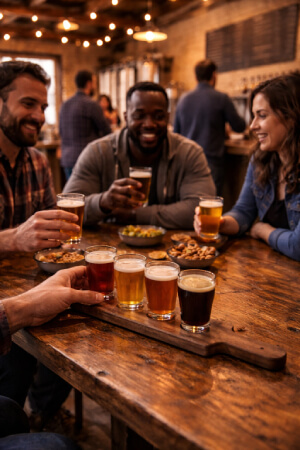
Tasting flights play a central role in taproom culture. By offering multiple small pours, they invite comparison and discussion. People often order flights together, turning individual preference into a shared activity that encourages dialogue.
This practice lowers the barrier to participation. One does not need expertise to comment on differences or express likes and dislikes. The format rewards curiosity and observation rather than authority, making the experience inclusive and social.
Ordering as Interaction, Not Transaction
In taprooms, ordering beer is often conversational rather than purely transactional. Staff explain styles, answer questions, and suggest options based on taste rather than trend. This exchange feels personal without becoming intrusive.
The bar becomes a point of contact rather than a boundary. Over time, repeated interactions build familiarity, reinforcing the taproom’s role as a social space rather than a service environment. The act of ordering becomes part of the social rhythm of the visit.
Pacing and Presence
Taproom rituals encourage slower pacing. Smaller pours, shared tasting, and conversation reduce the emphasis on rapid consumption. Time is spent talking, observing, and staying present rather than moving quickly from one drink to the next.
This pacing shapes the atmosphere. The taproom feels like a place to be rather than a place to pass through. Longer visits support deeper social engagement, allowing relationships and conversations to develop gradually.
Local Identity Without Location-Specific Branding
Although taprooms are deeply tied to local identity, this connection is expressed through social cues rather than explicit messaging. The sense of place emerges from who gathers there, how they interact, and what norms develop over time.
This approach allows taprooms to feel rooted without becoming exclusive. Identity is built through participation rather than symbolism. Newcomers can quickly feel included simply by observing and engaging with the existing social rhythm.
Familiar Faces and Social Recognition
Recognition plays a key role in shaping local identity. Being remembered, greeted, or acknowledged reinforces belonging. These moments are small, but they accumulate, creating a shared sense of ownership over the space.
Importantly, recognition remains informal. It grows organically through repeated presence rather than through membership or status. This preserves the taproom’s open character while still supporting strong social bonds.
Conversation as Cultural Expression
The topics discussed in taprooms often reflect everyday concerns and shared experiences. Work, weather, personal projects, and local observations circulate freely, grounding the space in lived reality rather than abstraction.
This conversational culture becomes the taproom’s true identity. It is not defined by décor or slogans, but by the patterns of speech, humor, and interaction that repeat within its walls. Culture emerges through talk rather than design.
Continuity Over Novelty
Taprooms tend to value consistency. While offerings may rotate, the social environment remains stable. This continuity encourages return visits and long-term attachment.
Rather than chasing novelty, taprooms build trust through familiarity. This steady presence supports their role as community spaces rather than entertainment venues, reinforcing their importance in everyday social life.
Social Norms That Define Taproom Culture
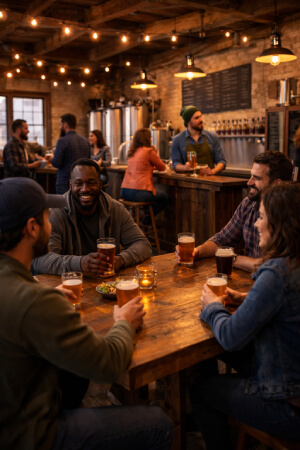
Taprooms operate through shared, often unspoken norms that shape behavior. These norms balance openness with respect, allowing diverse groups to coexist comfortably. They are learned through observation rather than enforcement, making them flexible but durable.
Understanding these norms helps explain why taprooms feel different from other drinking spaces. The culture emphasizes coexistence, moderation, and mutual awareness over competition or display.
- Conversation is encouraged but not imposed, allowing silence to coexist with sociability
- Space is shared, with seating and movement negotiated informally rather than claimed
- Drinking is secondary to presence, keeping focus on interaction rather than consumption
- Staff are part of the social environment, not separate from it
- Regularity is valued, but newcomers are welcomed without initiation
These norms provide structure without rigidity. They guide behavior while leaving room for individual expression and variation.
Why Taprooms Continue to Matter
Taprooms persist because they fulfill a social need that many modern spaces neglect. They offer a place to be present with others without obligation, performance, or distraction. In doing so, they restore everyday social interaction to a central role in public life.
As social spaces, taprooms succeed not through scale or spectacle, but through design, ritual, and repetition. Their value lies in consistency and accessibility rather than novelty. They remind people that community can form through ordinary encounters.
Where Conversation Takes the Lead
Different bar rooms show how it is possible for structures, conduct, and customs to come together in order to create "purposive" contexts for the fostering of genuine social relations. Promoting discourse, common activities, and laid-back camaraderie on the premises, these establishments have an equation of 1 minus meeting people, that is yet to exist.
The importance of these lies between people and what they do not in the bottles, but on the events in the people’s lives that, they do while there. This stands true since it is the younger generation that consumes media more than the old folks yet in taprooms you will sit with different people who will be involved and not glued on their screens.